Ship AI systems beyond the notebook.
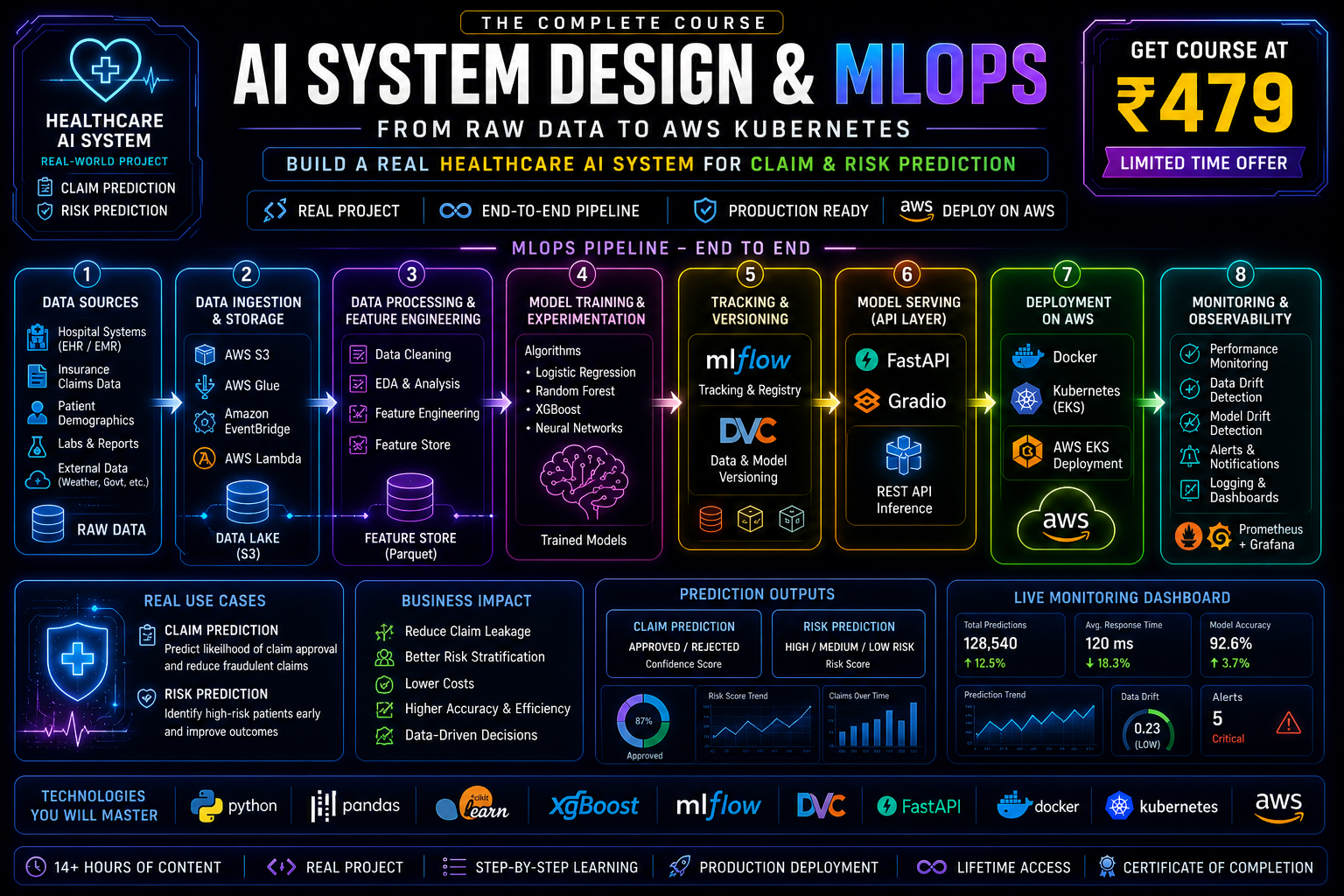
Build a real healthcare AI platform from raw data to a production deployment pipeline: EDA, feature engineering, MLflow experiments, DVC versioning, FastAPI serving, Docker, AWS EKS, monitoring, and drift detection.
Docker image, reproducible runtime, release path
model quality, drift checks, PSI-based monitoring
Most ML projects die between notebook and production.
A model is not a system. Production AI needs reproducible data, traceable experiments, deployable services, containerized runtimes, cloud orchestration, and monitoring that catches quality decay before users do.
Data foundations
Start with raw healthcare data, exploratory analysis, feature preparation, and reliable training inputs.
Experiment discipline
Track models with MLflow, compare metrics, and move from experiments into repeatable delivery.
Version everything
Use DVC so datasets, artifacts, and model lineage are not mystery files on someone else's machine.
Serve the model
Expose predictions through FastAPI and Gradio so the AI system has a real product surface.
Deploy like software
Package the system with Docker and push it toward AWS EKS instead of stopping at localhost.
Monitor drift
Watch production signals and PSI-based drift so model quality has operational visibility.
Everything needed to take ML from idea to runtime.
This course connects data science, backend engineering, cloud deployment, and production monitoring into one practical AI system design workflow.
"A trained model is only the beginning. The system around it decides whether it survives production."
The course is built around production workflows, not isolated notebook wins.A complete mental model for production AI.
Built as a production journey.
Each phase moves the project closer to a deployed system. You do not stop at model accuracy; you learn the architecture needed to operate the model.
Phase 1Phase 2Phase 3Phase 4Stop stopping at notebooks.
Build the pipeline, deploy the service, monitor the model, and understand the architecture that makes production AI real.